Harnessing WordPress User Meta Fields to Automate Personalized Alert Systems Based on Tipster Accuracy Thresholds in Prediction Services
Written by Devon Butler · Jul 13, 2026
Harnessing WordPress User Meta Fields to Automate Personalized Alert Systems Based on Tipster Accuracy Thresholds in Prediction Services
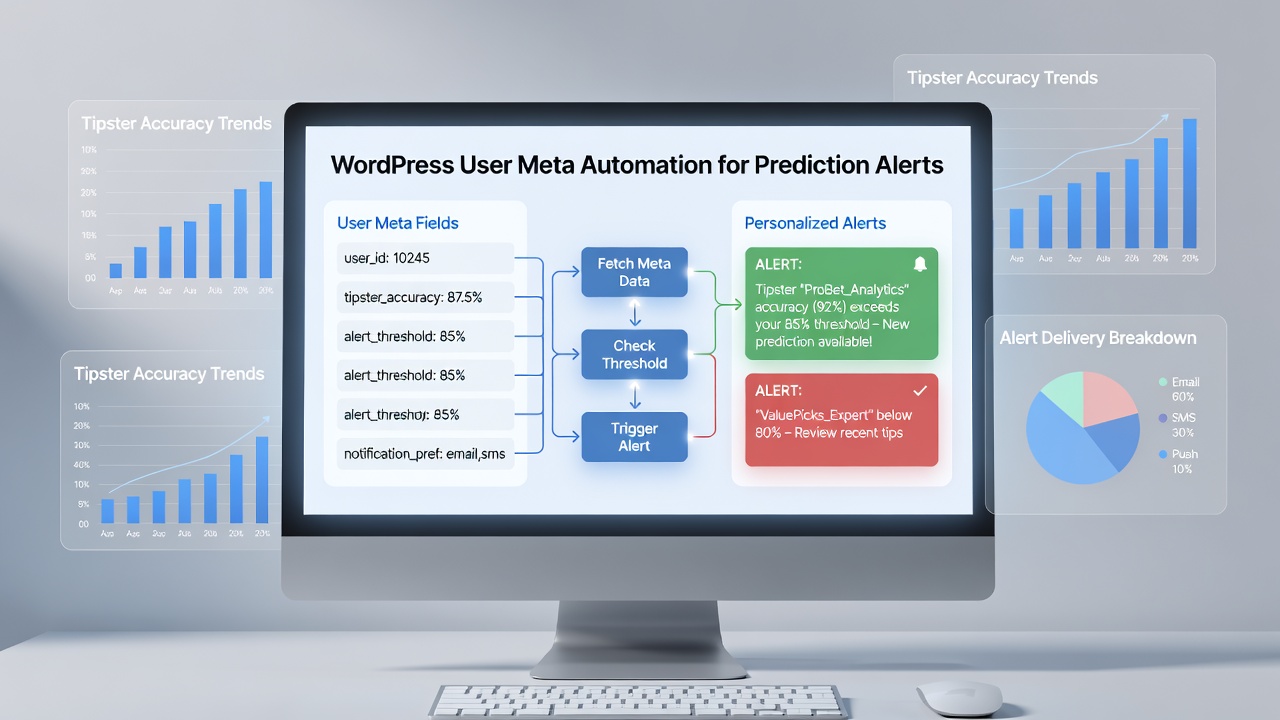
WordPress stores user information in dedicated meta tables that allow developers to attach custom data points to individual accounts without altering core database structures, and this capability supports automated systems that monitor tipster performance metrics in prediction platforms. Developers retrieve and update these fields through functions such as get_user_meta and update_user_meta, which operate directly on the wp_usermeta table and permit storage of accuracy percentages, historical strike rates, and threshold values assigned to each tipster profile.Core Mechanics of User Meta Storage for Accuracy Data
Accuracy thresholds function as numeric values saved against specific user IDs, enabling queries that compare current performance against predefined benchmarks. When a tipster's recorded accuracy reaches or exceeds a set level, the system triggers conditional checks during scheduled cron events that run hourly or daily depending on platform volume. These checks pull aggregated data from custom post types that hold prediction outcomes, then compare results against the stored meta values to determine alert eligibility.
Platforms often combine multiple meta keys, including total_predictions, correct_predictions, and accuracy_percentage, to calculate real-time figures before any notification fires. The calculation occurs server-side through PHP scripts that avoid exposing raw data to front-end users, thereby maintaining separation between administrative records and subscriber-facing displays. As of July 2026, several prediction services reported increased adoption of such meta-driven workflows following updates to WordPress core that improved cron reliability and user query performance.
Building Threshold-Based Alert Triggers
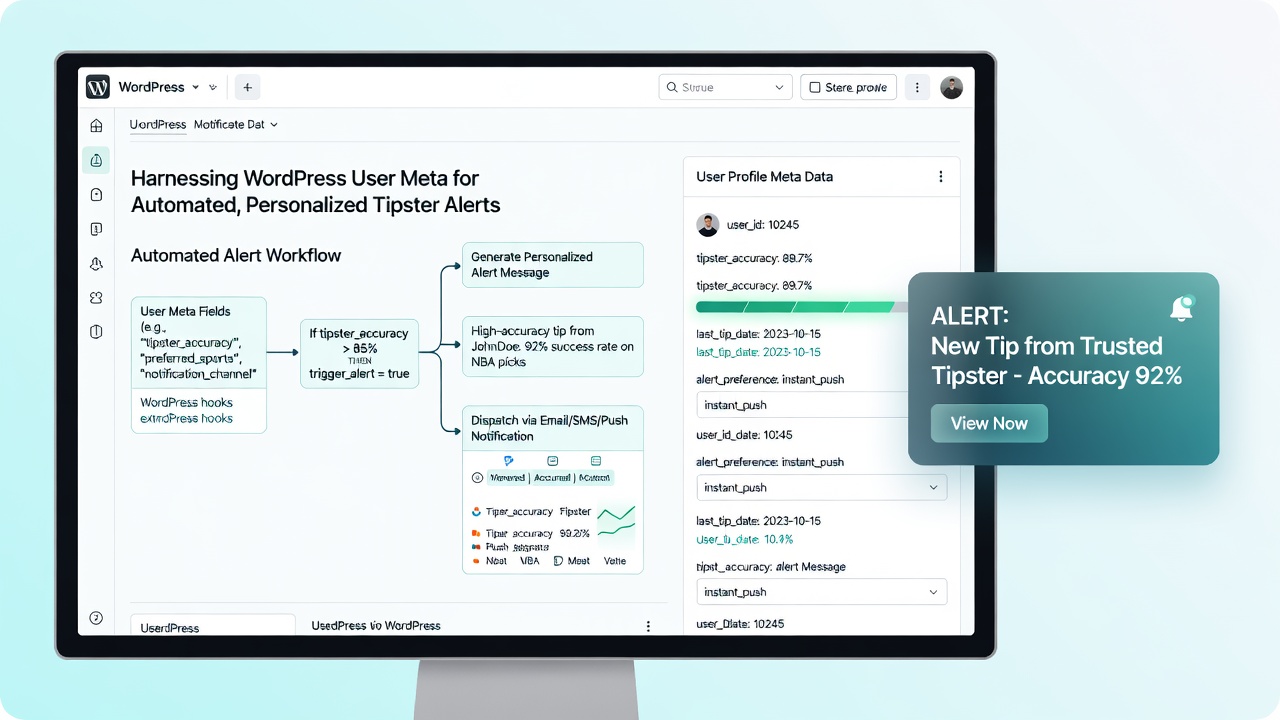
Alert automation relies on action hooks attached to user meta updates, so that any change in accuracy data automatically evaluates against subscriber preferences stored in separate meta fields. A subscriber might select to receive notifications only when a tipster surpasses an 75 percent accuracy mark over the preceding thirty days, and the system stores this preference as a serialized array under a key such as alert_thresholds. When the tipster meta updates, a callback function iterates through all subscribers who have matching criteria and queues personalized messages via WordPress email APIs or integrated notification plugins.
This approach avoids polling entire user tables on every request and instead uses targeted queries that filter by meta_value ranges, reducing database load during peak traffic periods. Industry reports from the Interactive Advertising Bureau indicate that automated personalization systems built on similar meta architectures have contributed to higher retention rates in content subscription models across digital platforms.
Integration with Subscription and Notification Layers
Prediction services frequently link accuracy meta fields to role-based access controls, so that subscribers at different tiers receive alerts scoped to tipsters whose performance aligns with their chosen plan. Developers implement this by registering custom capabilities that reference meta values, allowing plugins to gate content or notifications accordingly. Scheduled tasks written with WP-Cron or external schedulers execute the comparison logic outside of page loads, ensuring consistent delivery regardless of site traffic.
Data validation routines run before meta updates to prevent invalid accuracy entries from propagating into alert decisions, and these routines often include cross-checks against historical records stored in custom tables. External services such as the Australian Communications and Media Authority have published guidelines on transparent data handling in automated notification systems, which many platforms reference when configuring consent flows for alert subscriptions.
Scaling and Maintenance Considerations
Larger installations distribute meta queries across object caches to prevent repeated database hits when evaluating thresholds for thousands of tipster accounts. Cache invalidation occurs immediately after any accuracy recalculation, maintaining synchronization between stored meta values and active alert conditions. Regular audits of meta key usage help identify orphaned data from decommissioned tipster profiles, keeping the system efficient over time.
Developers also implement logging mechanisms that record each alert dispatch alongside the meta values that triggered it, creating an audit trail useful for troubleshooting or compliance reviews. These logs typically reside in separate custom tables rather than bloating user meta, preserving query speed while retaining necessary historical context.
Conclusion
WordPress user meta fields provide a flexible foundation for accuracy-threshold alert systems in prediction services by storing and querying individualized performance data through established core functions. The combination of meta storage, cron-based evaluation, and subscriber preference fields creates automated workflows that deliver timely notifications without manual intervention. As platforms continue to refine these implementations, the underlying architecture remains grounded in standard WordPress data handling practices that scale across varying site sizes and traffic levels.